Why Do I Crave Junk Food? The Real Science Behind Your Cravings
Have you ever wondered why do I crave junk food so intensely, even when you aren’t actually hungry? If you constantly find yourself reaching for sugary, salty, or fatty snacks late at night, you aren’t weak-willed. Your brain is simply responding to millions of years of human evolution and advanced food manufacturing.
Understanding the food science behind cravings is the first step to regaining control. Here is a breakdown of why ultra-processed foods are so addictive and how to rewrite your brain’s biological programming.
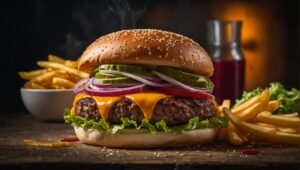
1. The Evolutionary Trap: Wired for Sugar and Fat
 For the vast majority of human history, food was scarce. To survive, the human brain evolved a mechanism called “hedonic hunger“—the desire to eat for pure pleasure and calorie storage rather than immediate survival.
Our ancestors learned to seek out two specific types of food:
- Sweet Foods: In nature, sweetness signifies quick calories and safe, non-poisonous plants.
- Fatty Foods: Fat provides dense, long-lasting energy needed to survive periods of starvation.
In the past, overeating these rare resources kept us alive. Today, calories are available at every street corner, but our ancient biology still screams, “Eat as much fat and sugar as you can before it runs out!”
2. The Food Science Behind Cravings: The Bliss Point
Modern junk food doesn’t taste good by accident. Food manufacturers employ highly skilled scientists who use data and chemistry to target your brain’s reward system, specifically triggering a massive release of dopamine (the “feel-good” chemical).
They achieve this through three precise scientific concepts:
- The Bliss Point: This is the exact mathematical combination of sugar, salt, and fat that maximizes pleasure without triggering the brain’s natural “stop eating, you’re full” mechanism.
- Vanishing Caloric Density: Foods like cheese puffs are engineered to melt instantly in your mouth. This tricks your brain into thinking the calories have vanished. Because your stomach doesn’t register physical volume, you can easily finish an entire bag.
- Dynamic Contrast: The human brain loves sensory novelty. Foods that feature dynamic contrast—like a crunchy chip with a smooth dip—keep the brain stimulated so you don’t get bored of the flavor profile.
3. The Hormonal Hijack: Stress and Sleep Deprivation
Your daily lifestyle choices heavily dictate why do I crave junk food. Cravings are rarely just about willpower; they are deeply tied to your hormonal health.
The Link Between Stress and Junk Food Cravings
When you are chronically stressed, your body releases a hormone called cortisol. Cortisol actively increases your appetite and directs your cravings specifically toward high-calorie “comfort foods.” The brain uses the resulting dopamine spike to temporarily blunt its stress response, turning junk food into a form of self-medication.
The Sleep Deficit
Getting less than seven hours of sleep throws your hunger hormones completely out of balance. Your body increases production of ghrelin (the hormone that triggers hunger) and decreases leptin (the hormone that signals fullness). Brain scans of sleep-deprived individuals show significantly higher activation when looking at junk food compared to healthy options.
4. How to Stop Junk Food Cravings for Good
You cannot change your evolutionary biology overnight, but you can change your environment to beat the system. If you want to know how to stop junk food cravings, implement these three evidence-based steps:
- Hide the Cues: The brain responds heavily to visual prompts. If cookies are sitting on your kitchen counter, you will eventually eat them. Keep junk food completely out of sight, or better yet, don’t buy it.
- Manage the Triggers: Before reaching for a late-night snack, evaluate your fatigue and anxiety levels. Address the root cause with an early bedtime, a glass of water, or a five-minute walk.
- Reset Your Taste Buds: Ultra-processed foods dull your taste receptors. By cutting back on junk food for just two weeks, your taste buds will adapt, and natural foods like fresh berries will begin to taste noticeably sweeter and more satisfying.